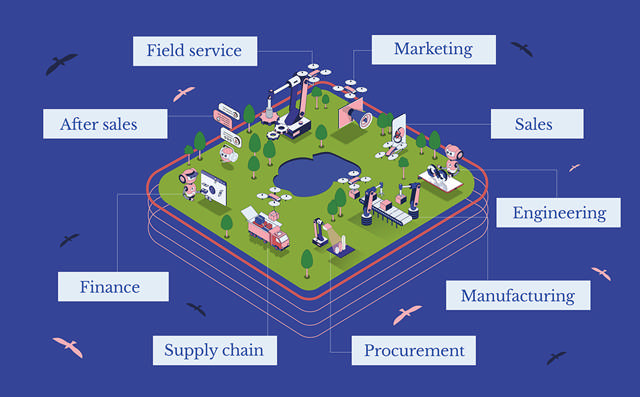
Not all ERP data is directly relevant to marketing, but these key types can significantly improve segmentation and campaign performance:
Financial data
- Invoice history
- Average order value (AOV)
- Credit limits and payment behavior
Operational data
- Logistics and delivery details
- Returns and service history
Customer behavior and interaction data
- Purchase frequency
- Product preferences
- Engagement with marketing (emails, ads, etc.)
How do you connect Customer Insights with ERP and CRM?
To create an effective marketing strategy, you need a complete view of your customer. That means combining data from multiple systems. Microsoft Dynamics 365 Customer Insights makes it possible to bring together data from CRM and ERP (such as Dynamics 365 Finance & Supply Chain Management).
Here’s how to integrate ERP data into your segmentation in four steps:
1. Import ERP data (F&O) into Customer Insights
Your Finance & Supply Chain Management system contains crucial information on orders, payments, stock levels, and customer transactions. By importing this data into Customer Insights, you gain insight into customers’ financial standing, order history, and the operational processes linked to their interactions. You can create segments based on frequency, payment behavior, product preferences, and more.
2. Import CRM data into Customer Insights
Your CRM holds valuable details on customer contacts, interactions with sales and marketing teams, and past campaigns. Combine this with your ERP data and you now have a complete 360° customer view.
3. Use AI & Machine Learning in Customer Insights
Customer Insights leverages Microsoft Copilot and machine learning to analyze behavior, detect patterns, and predict purchases. This helps you identify high-value customers and at-risk segments, making your campaigns more targeted and effective.
4. Activate insights through Marketing & Sales
The final step is to act on your insights. Launch highly targeted campaigns such as personalized emails, social media ads, and tailored sales recommendations. Your operational teams can also better manage customer expectations with personalized order updates—boosting satisfaction and conversion rates.